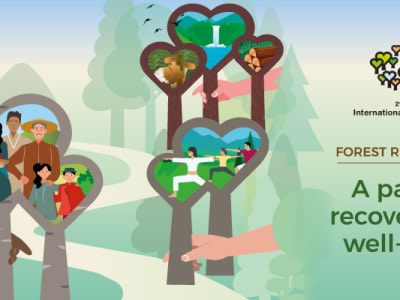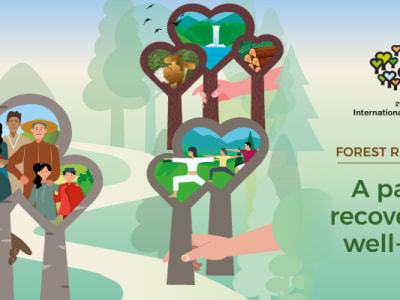






One 21 March the Zimbabwean forestry community and environmentalists celebrated the International Day of Forests. The United Nations General Assembly proclaimed 21 March the International Day of Forests (IDF) in 2012. The Day celebrates and raises awareness of the importance of all types of forests. On each International Day of Forests, countries are encouraged to undertake local, national and international efforts to organize activities involving forests and trees, such as tree-planting campaigns. It is with this in mind that the Green Hut Trust a Non-Profit Organisation led by Ms Cinderella Ndlovu organised a webinar to commemorate this day by highlighting the grass root work and experiences of the event panellists and the organisations that they represented. According to Cinderella, Green Hut Trust objectives include inspiring, promoting and supporting environmental consciousness, responsibility and sustainable development amongst rural and urban communities in Zimbabwe. The webinar had more than 35 participants from various countries including Malawi, Mozambique and Bosnia Herzegovina and was co-sponsored by the Forestry Commission of Zimbabwe. The theme for 2021 is "Forest restoration: a path to recovery and well-being".

Cinderella Ndlovu
Bio-economies
First on the platform, was Dr Tatenda Mapeto from Matabeleland Sustainability and Development Trust. Dr Mapeto challenged Zimbabweans to reimage, rethink and redesign our economic model towards reducing our dependence on non-renewable resources and recycling. According to Dr Mapeto, “The world needs circular bio-economy solutions and the forestry industry can step into the spotlight to offer one”. The term bio-economy refers to economic activities involving the use of biotechnology and biomass in the production of goods and services. Bio-economic streams include agriculture, forestry, fisheries, wood and paper and bio-fuel. Lastly, Dr Mapeto stressed that the path to restoration and recovery to wellbeing must be underwritten by educational frameworks. Education must ensure that we instil and enculturate the lessons we have learnt to our youth and children so that the future will be always be cautioned.

Dr. Tatenda Mapeto
Forestry restoration and gender equality
The Director of Environment Buddies – Zimbabwe, Shamiso Mupara highlighted the importance of mainstreaming gender equality in the restoration of forests in Zimbabwe. Women and girls are disadvantaged by insecure access and property rights to forests, trees and land resources by discrimination and male bias in service provisions like credit, technology, right to schooling and by being excluded in decision making and policy formulation at household and community level. According to Ms Mupara “reducing the gender gap in forestry can also help to achieve the broader social and economic goals including the Sustainability Development Goals. Asked about how Environment Buddies – Zimbabwe is mainstreaming gender in forestry? Ms Mupara indicated that her organisation was involved in various projects which sort to increase the participation of women such as small-medium enterprises, Bursaries for the girl child, establishment of family woodlots and gardens and tree plantation projects.

Shamiso Mupara
“Participation of local communities is key for Forest restoration”
The above sentiment was echoed by Felix Matutu from Forestry Commission – Zimbabwe based in the town of Gwanda, a parastatal organisation under the Ministry of Environment, Climate, Tourism and Hospitality. The Forestry Commission is responsible for the regulation, management and conservation of forest resources in Zimbabwe. According to Felix the participatory methods include a range of activities with a common thread: enabling ordinary people to play an active and influential part in decisions that affect their lives. This means that people are not just listened to but also heard; and that their voices shape the outcomes. Forestry Commission restoration projects include; family woodlots, family orchards, soil rehabilitation projects, the national tree planting day and enforcing tree protection legislation.

Felix Matutu
Forest Governance and legislation
According to Tatenda Gotore, Research Officer Silviculture, Forestry and Climate at Forestry Commission – Zimbabwe, two major legislations regulate forestry in Zimbabwe. These are the Forest Act and the Communal Land, Forest and Produce Act;
The Forest Act gives the Forestry commission its mandate and also speaks to the conservation of indigenous forests, regulation and control of diseases and pests, fire management and the cutting of trees.
The Communal Land Forest and Produce Act regulates the exploitation and protection of communal land and encourages the establishment of plantations.
Furthermore, the Forestry Commission has a conservation department resourced with extension/community officers who are responsible for the implementation of these policies on the ground.

Tatenda Gotore
“Let’s identify the root cause of forest depletion and environmental degradation”
Lauretta Marembo, from an organisation called Young Volunteers for the Environment, called on young people to be bold and call out the root causes of environmental degradation. “Identification of root cause is paramount towards the formulation of the right solutions”, said Lauretta. She urged young people to advocate more for policies that consider them and their future into consideration.

Lauretta Marembo
Two participants were asked about their take of the webinar and whether their expectations were met?
Shylet Tsoca a Lecturer at the Instituto Superior Politecnico de Manica, Mozambique had this to say:
“I found today's webinar interesting and it touched on fundamental issues that include forestry creation, management and protection. In Mozambique, a big chunk of the population still uses charcoal for cooking and this is causing a noticeable dent in our forests and I believe it is high time that we look for alternatives because the issue of anthropogenic climate change is a reality and it is further affecting agriculture and the way of life of many citizens”
Emir Delic, a Forest Engineer at the Centre for Sustainable Development (COR), the University of Bihac in Bosnia Herzegovina;
“I was expecting to hear a few of those environmental concerns Zimbabwe is
faced with. Zimbabwe being listed in Global South as being one of Africa’s
poorest countries, where most of the country’s population lives in
rural areas with livelihoods dependant on forests, it was interesting to learn of the solutions to those challenges on the ground”